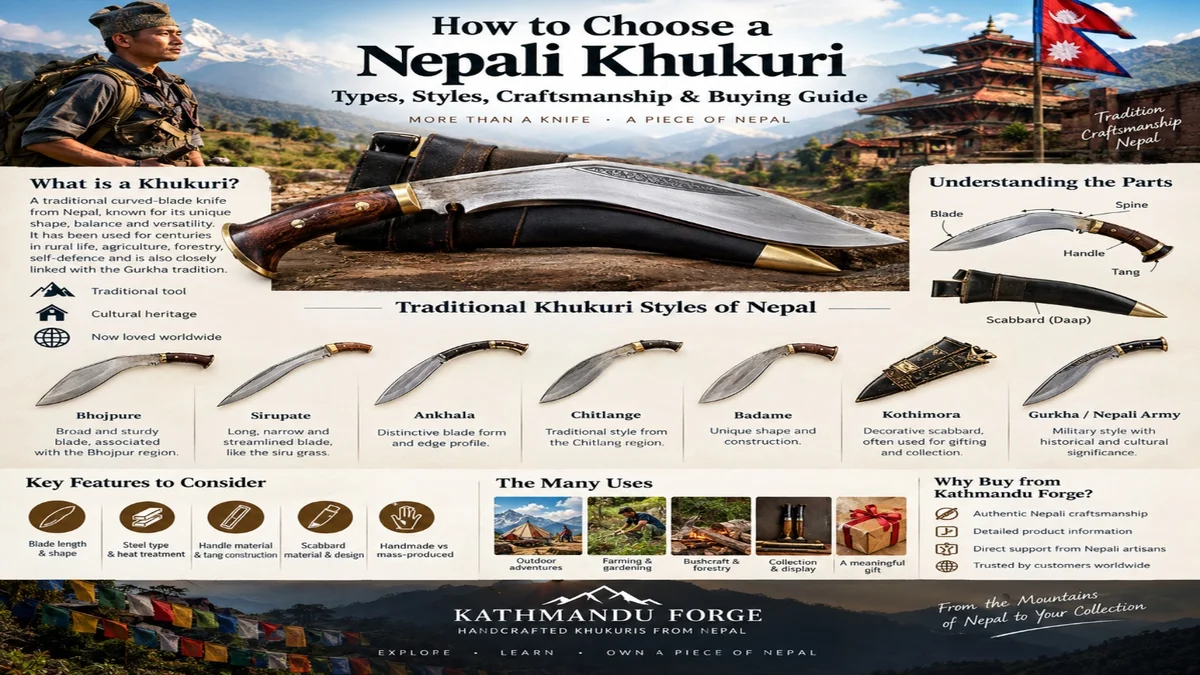
Choosing a Nepali Khukuri is not simply about choosing a curved blade.
For someone seeing a Khukuri for the first time, many traditional knives may appear similar.
They have a curved blade.
They may have a wooden handle.
They may come with a leather-covered scabbard.
But once you look more closely, you begin to notice something interesting.
Khukuris are not all the same.
Different regions, craftsmen, blade shapes, handle designs, scabbards and intended purposes have contributed to the wide variety of Khukuris found in Nepal.
Some are broad and powerful.
Some are long and slender.
Some are highly decorative.
Some have a simple traditional appearance.
Some are made primarily for practical work, while others are particularly attractive to collectors and people interested in Nepalese heritage.
So how do you choose the right one?
The answer starts with understanding what you are looking at.
At Kathmandu Forge, we believe that customers should not have to choose a Khukuri based only on a photograph.
Understanding the blade, handle, tang, scabbard, craftsmanship, style and intended purpose can help you appreciate the product before making a purchase.
Why Are There Different Types of Khukuris?
One of the first things a new buyer discovers is that there is no single universal Khukuri design.
Different traditional styles have developed in different places and through different artisan traditions.
The differences can appear in:
- Blade length
- Blade width
- Blade curvature
- Spine thickness
- Edge profile
- Handle shape
- Handle material
- Tang construction
- Scabbard design
- Decorative details
- Overall proportions
This variety is part of what makes collecting Nepalese Khukuris interesting.
A person who owns one style may eventually become interested in another because the two pieces can represent completely different aspects of Nepalese craftsmanship.
Traditional Nepali Khukuri Styles
Below are some of the traditional styles that customers may encounter when exploring Nepalese Khukuris.
1. Bhojpure Khukuri
The Bhojpure Khukuri is traditionally associated with the Bhojpur region of eastern Nepal.
It is generally recognized for its broad and sturdy blade profile.
Its appearance gives it a strong traditional character, making it interesting to people who want to explore regional forms of Nepalese Khukuri craftsmanship.
For collectors, a Bhojpure Khukuri can represent the connection between a particular geographical region and its traditional blade-making practices.
What makes it interesting?
- Broad traditional blade profile
- Strong visual character
- Association with Bhojpur
- Popular among traditional Khukuri enthusiasts
- Suitable for collectors interested in regional styles
2. Sirupate Khukuri
The Sirupate Khukuri is one of the most recognizable traditional styles.
It generally features a longer, narrower and more streamlined blade compared with broader Khukuri forms.
The name is associated with siru, a type of grass found in Nepal, and the blade's appearance is often described in relation to the shape of that grass.
For someone who prefers a more slender and elegant-looking traditional Khukuri, the Sirupate style can be particularly appealing.
What makes the Sirupate distinctive?
- Long and relatively narrow blade
- Streamlined appearance
- Distinctive traditional profile
- Strong visual appeal for collectors
- Associated with Nepalese regional craftsmanship
3. Ankhala Khukuri
The Ankhala Khukuri represents another traditional form within Nepal's diverse Khukuri-making traditions.
Its blade shape and edge profile give it an appearance different from broader or more streamlined styles.
As with other handmade Khukuris, individual examples can vary according to the craftsman, materials and finishing.
This is an important point for buyers:
Traditional style does not mean every individual Khukuri will be identical.
4. Chitlange Khukuri
The Chitlange Khukuri is associated with the Chitlang region of Nepal.
Regional styles are particularly interesting because they connect a physical object with a specific place.
When you purchase a regional Khukuri, you are not simply looking at the shape of the blade.
You are also exploring a part of Nepal's wider artisan tradition.
For collectors who enjoy understanding where traditional products come from, regional Khukuri styles can add another layer of interest.
5. Badame Khukuri
The Badame Khukuri is another traditional Nepalese form recognized for its distinctive shape and construction.
Like many traditional styles, its appearance can vary depending on the individual maker.
This is why it is useful to study the actual product rather than relying only on the name of the style.
A product description should ideally tell you:
- Blade length
- Blade material
- Handle material
- Overall length
- Weight
- Tang construction
- Scabbard material
- Handmade details
6. Kothimora Khukuri
The Kothimora Khukuri is especially interesting because the scabbard is an important part of its identity.
Unlike a simple utility-oriented scabbard, Kothimora-style presentation can feature decorative craftsmanship.
This makes the style particularly interesting for:
- Collectors
- Cultural displays
- Traditional gifts
- Nepalese heritage enthusiasts
- People interested in decorative craftsmanship
A Kothimora Khukuri demonstrates an important point:
Khukuri craftsmanship does not end with the blade.
The scabbard can be an important part of the overall artistic presentation.
7. Nepali Army and Gurkha-Style Khukuri
Another category commonly encountered by collectors is the Nepali Army or Gurkha-style Khukuri.
These styles are connected with military traditions and the long association between the Khukuri and Gurkha service.
For collectors, their attraction can come from:
- Military heritage
- Traditional appearance
- Historical associations
- Distinctive construction
- Connection with Gurkha traditions
However, buyers should distinguish between an authentic historical military item and a modern Khukuri made in a military-inspired style.
Those are not necessarily the same thing.
The Beauty of Natural Wood
One of the things that makes handmade Khukuris attractive is the use of natural materials.
Wood is not a completely uniform material.
The grain can change.
The color can vary.
The texture can differ.
Small marks and variations may occur naturally.
For a mass-produced product, uniformity is often the goal.
For a handmade product, natural variation can be part of its character.
This is particularly important when buying a Khukuri online.
The product you receive may have slight differences from the exact appearance shown in a photograph because natural materials are individual.
The Khukuri Scabbard
The scabbard is another important part of the traditional Khukuri.
Traditionally, the Khukuri is carried in a protective sheath or daap.
The scabbard serves a practical purpose, but it also contributes to the visual identity of the Khukuri.
Depending on the style, it may be:
- Simple
- Leather-covered
- Traditionally decorated
- Highly ornamental
- Designed for a particular regional style
For collectors, the scabbard can be just as interesting as the blade.
This is especially true for decorative styles such as Kothimora Khukuris.
The Importance of the Complete Khukuri
A common mistake among first-time buyers is to focus entirely on the blade.
A traditional Khukuri should be considered as a complete object.
Look at:
Blade + Handle + Tang + Scabbard + Fittings + Construction + Craftsmanship
These elements work together.
A beautiful blade with poor finishing elsewhere may not provide the same experience as a carefully constructed complete Khukuri.
That is why Kathmandu Forge presents product information covering the complete piece rather than focusing only on blade length.
What Can a Khukuri Be Used For?
The Khukuri has traditionally had practical applications.
In rural parts of Nepal, traditional Khukuris have been associated with work involving:
- Grass
- Firewood
- Agriculture
- Livestock-related work
- Forest travel
- General cutting and chopping
Its practical character is part of the reason it became deeply familiar within traditional Nepali life.
Today, different Khukuri designs may also attract people interested in:
Outdoor Activities
Camping and outdoor enthusiasts may appreciate the traditional design and chopping character of appropriate Khukuri models.
Bushcraft
People interested in traditional outdoor tools may be attracted to the Khukuri's distinctive design.
Farming and Gardening
Certain designs may be relevant to appropriate cutting and clearing tasks.
Collecting
Collectors may choose Khukuris based on regional style, craftsmanship, historical association or visual character.
Cultural Display
A traditional Khukuri can be displayed as an example of Nepalese craftsmanship.
Gifts
A handmade Khukuri can be a distinctive gift for someone interested in Nepal or traditional craftsmanship.
Always consider the specific design, intended use and applicable laws before purchasing, transporting, carrying or using a Khukuri.
How to Choose a Khukuri for Your Purpose
Now we come to the most important question:
Which Khukuri should you choose?
There is no universal answer.
Instead, start with your reason for buying.
If You Are a Collector
Look for:
- Traditional regional styles
- Distinctive blade profiles
- Interesting scabbards
- Handmade construction
- Detailed specifications
- Clear information about origin
You may eventually find yourself wanting several styles because each one offers something different.
If You Appreciate Nepalese Culture
Look for a Khukuri that clearly represents traditional Nepalese craftsmanship.
A regional style can be particularly interesting because it gives the product a connection to a specific part of Nepal.
If You Are Buying a Gift
Consider the person's interests.
A decorative traditional Khukuri may appeal to someone interested in Nepalese heritage.
A more practical design may appeal to someone interested in traditional outdoor tools.
The best choice depends on the recipient rather than simply choosing the most expensive product.
If You Are Interested in Outdoor Use
Pay particular attention to:
- Blade dimensions
- Steel
- Heat treatment
- Tang construction
- Handle construction
- Weight
- Scabbard
- Intended use
Do not choose an outdoor tool based only on the appearance of the blade.
Why Buy Your Khukuri From Kathmandu Forge?
At Kathmandu Forge, our relationship with Khukuris started at home.
Our journey began with two sisters selling traditional Khukuris in Nepal.
Over time, we realized that there was much more to the Khukuri than simply selling a knife.
We became interested in the details behind the product:
How is it made?
Why are there different styles?
What makes one blade different from another?
What role does the handle play?
Why do traditional scabbards look different?
How can customers outside Nepal understand what they are purchasing?
These questions became part of our business.
Today, Kathmandu Forge connects the work of Nepali artisans with customers in Nepal and around the world.Discover Traditional Khukuris From Kathmandu Forge
A Khukuri can be many things at once.
It can be a traditional Nepalese craft.
It can be a practical tool.
It can be a collector's piece.
It can be a cultural gift.
It can be a reminder of Nepal.
And it can be an example of what skilled hands can create from steel, wood and traditional knowledge.
At Kathmandu Forge, we are proud to connect these handmade products with customers around the world.
Our goal is not simply to sell a Khukuri.
It is to help customers understand what they are buying and appreciate where it comes from.
Explore our collection and discover the different styles, constructions and craftsmanship that make Nepalese Khukuris unique.
From Kathmandu to Your Collection
Made in Nepal.
Crafted with tradition.
Discovered by the world.
Explore Kathmandu Forge and find your Khukuri.
Frequently Asked Questions
What is the difference between a Khukuri and a Kukri?
Khukuri and Kukri are commonly used English spellings for the traditional Nepalese curved knife. You will see both spellings used online.
Are all Nepalese Khukuris the same?
No. Traditional Khukuris come in different styles and can vary in blade shape, dimensions, handle design, scabbard, construction and decorative details.
What is a Bhojpure Khukuri?
A Bhojpure Khukuri is a traditional style associated with the Bhojpur region of Nepal and is generally recognized for its broad, sturdy appearance.
What is a Sirupate Khukuri?
A Sirupate Khukuri is traditionally recognized by its relatively long, narrow and streamlined blade profile.
What is a Kothimora Khukuri?
A Kothimora Khukuri is a traditional style particularly known for its decorative scabbard and is often appreciated for collection, display and gifting.
Are handmade Khukuris identical?
Not necessarily. Handmade products can have small variations in dimensions, wood grain, surface finish and other details.
What is a Khukuri used for?
Traditional Khukuris have been associated with practical cutting and chopping work as well as military use. Specific modern uses depend on the individual design and local laws.
What should I check before buying a Khukuri?
Look at the origin, blade length, steel, handle material, tang construction, weight, scabbard, intended purpose and seller's product information.
Why buy a Khukuri made in Nepal?
For customers interested in Nepalese craftsmanship, a Khukuri made in Nepal provides a direct connection to the country and its traditional artisan practices.
Why choose Kathmandu Forge?
Kathmandu Forge is a Nepal-based business connecting customers with traditionally crafted Khukuris, swords and knives made in Nepal, with an emphasis on product information, craftsmanship and traditional character.
Categories
Recent Posts
 Featured
 Featured
 Featured