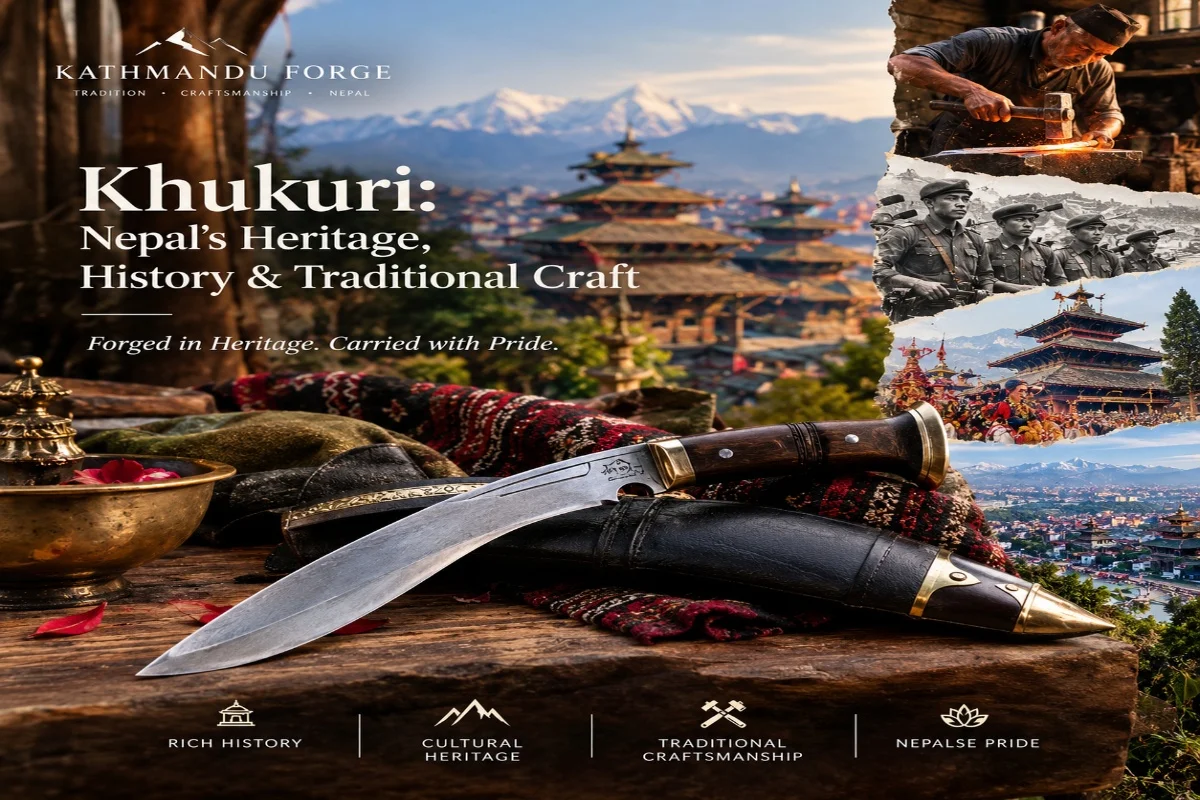
Khukuri: Nepal’s Heritage, History & Traditional Craft
Forged in Heritage. Carried with Pride.
A khukuri is not merely a sharp edge of iron. A sword is not merely a weapon of war. A knife is not merely a tool.
These are history, bravery, culture, and generations-old Nepali heritage engraved in metal.
Kathmandu Forge is an honest effort to carry this heritage forward to the modern generation.
Khukuri: The Identity of Nepal
The khukuri is an inseparable companion of Nepali life.
From the khukuri that became the identity of brave Gurkhas to traditional edged weapons associated with courage and self-respect, these are not merely objects but living symbols of Nepali history.
During the campaign to unify Nepal, the khukuri carried by Gurkha warriors carried the story of Nepali bravery.
Even today, through its association with Gurkha soldiers, the Gurkha khukuri is known around the world as a symbol of Nepali courage and identity.
Think of Prithvi Narayan Shah, who unified Nepal. In every photograph and painting we have seen, he is shown carrying a sword.
The Ancient Legend of Kathmandu
A famous mythological story is associated with the history of the Kathmandu Valley.
According to belief, in ancient times, the valley we know today was a vast lake.
According to Buddhist tradition, Manjushri cut through the mountain at Chobhar with his sword, created an outlet for the water, and allowed the water of the lake to flow out.
After the water drained away, the valley became suitable for human settlement, and it was on this very land that the civilization of Kathmandu developed.
Whether one believes it or not is a matter for each person.
But when looking at the hill at Chobhar, it really seems as though it happened that way. Even today, the water of the Bagmati flows out of the Kathmandu Valley through a narrow gorge between large rocky mountains.
After Manjushri used his sword to let the water flow away, the soil that appeared was the same fertile soil on which our ancestors cultivated the land, established settlements, and began jatras and festivals.
Even today, Manjushri and Saraswati are worshipped on Basanta Panchami.
Although the story is old, its imprint is still alive in our lives.
That is why, for us, a sword is not only a blade — it is also a symbol of transformation.
A blade can open a path.
A blade can write history.
A blade can carry the story of a civilization for generations.
The Khukuri in Our Daily Life
The khukuri is not found only on the battlefield. It is also present in our courtyards, fields, and kitchens.
Early in the morning, a farmer cutting grass has a khukuri at his waist.
In the forest, the hand splitting firewood holds a khukuri.
From making utensils in villages to preparing and managing farmland, somewhere or another, the edge of a khukuri is always at work.
Every year, on Asoj 1, the day of Vishwakarma Puja, and on Navami during Dashain, we worship our tools and weapons because these very tools sustain our lives.
On that day, skill and tools are honored.
The furnace, hammer, and anvil are worshipped because they are the very instruments that support the hands that create.
In our workshop too, on that day, the tools receive a rest and the skill of the craftsman receives respect.
And that same khukuri is passed down from generation to generation.
The khukuri carried by a grandfather reaches the hands of his son, and the father's khukuri reaches the hands of his son.
In many homes, that khukuri is not merely an object; it is a living memory of the ancestors.
Behind all of this are our skilled Kami (Vishwakarma) craftsmen, whose hands have been shaping iron for years.
It is the heat, sweat, and skill of those hands that have given the khukuri its soul.
Our Craft, Our Heritage
At Kathmandu Forge, we see khukuris, swords, and knives not merely as products, but as representatives of Nepali craftsmanship, history, and tradition.
From the heritage of the Gurkha khukuri to the tradition of Nepali metalwork, our purpose is to connect the old identity with the modern era.
Every blade has a story.
Every form has a tradition.
Every piece has a part of Nepal.
Kathmandu Forge — Where History Is Engraved in Iron
Our work is connected to a heritage that has been shaped by generations of craftsmanship, culture, and tradition.
For us, a handmade khukuri is more than a product. It represents the hands that forged it, the traditions behind it, and the story it carries from Nepal to the world.
Forged in Nepal. Inspired by History. Built to Preserve Heritage.
Categories
Recent Posts
 Featured
 Featured
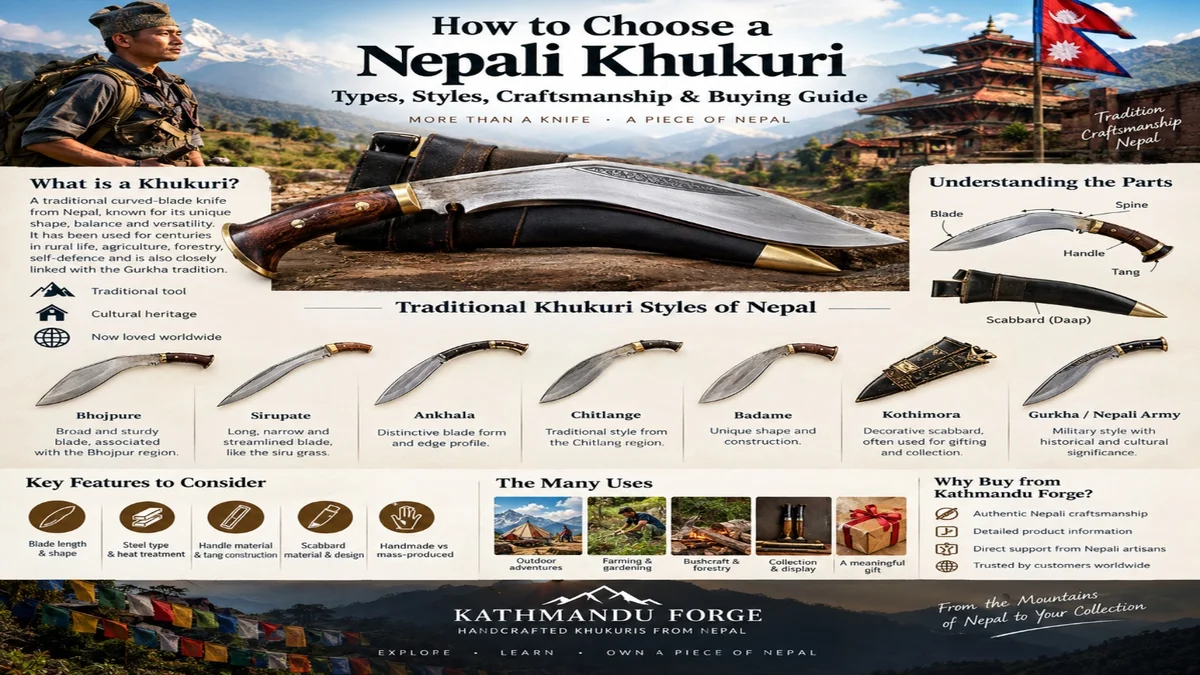
How to Choose a Traditional Nepali Khukuri: A Complete Guide to Styles, Craftsmanship, Uses and Buying
Sep 22, 2026
Read Post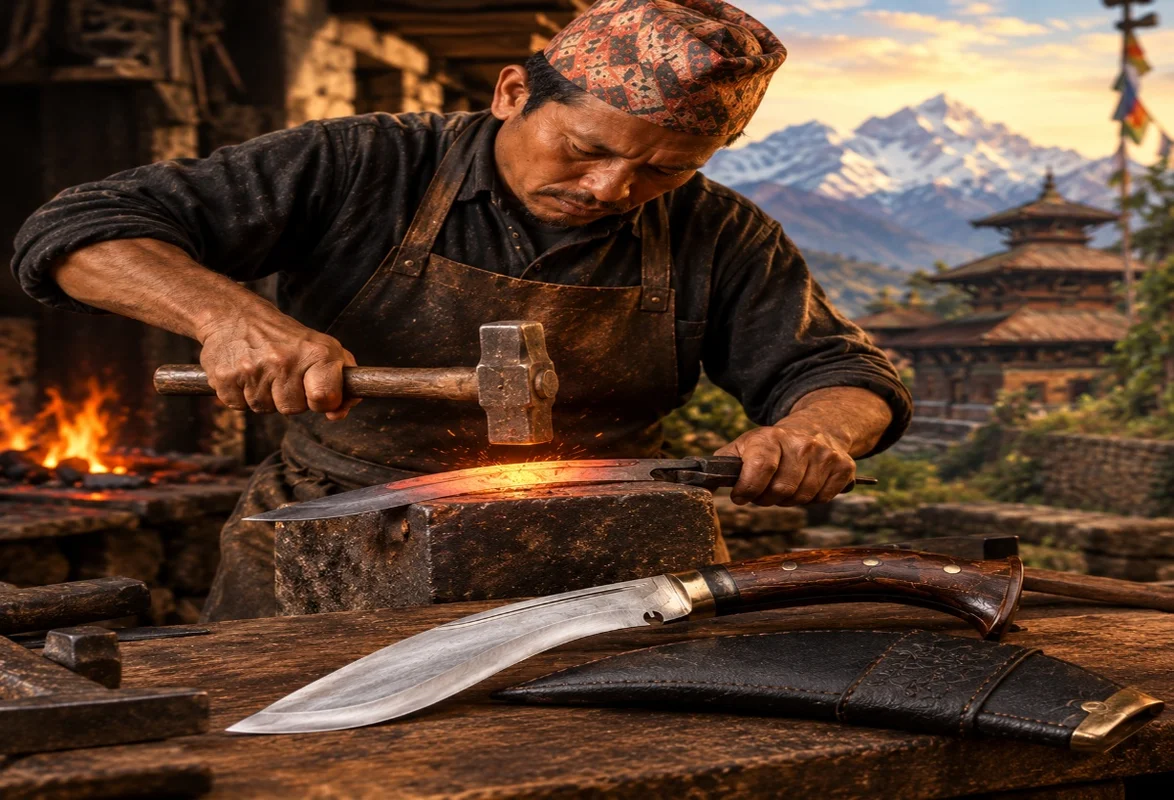 Featured